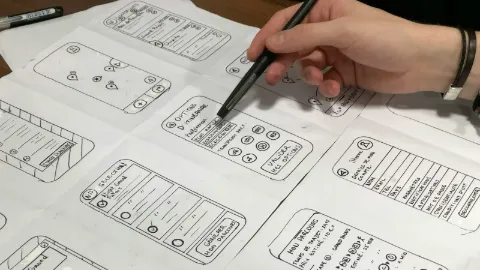
Website Redesign
A website redesign means the existing site gets a new look, a faster foundation and a proper layout on a phone — while keeping the address, the content and the rankings it has earned on Google so far. The companies that come to us are usually the ones that have outgrown their own site: the business has moved on, the offering has changed, and the site is still telling a story from five years ago.
When it is time for a website redesign
There is no rule that a website lasts exactly so many years. There are signs, and they usually pile up several at once. The most common one is the phone: the site was built when most traffic came from desktops, so today you have to zoom in and drag left and right. Since Google ranks the mobile version of a page, that is not just a question of looks but of rankings.
The second sign is speed. A site that takes four seconds to load loses visitors before they have seen anything, and a slow site ranks worse. The third is not being able to change it — if you have to call somebody for every little thing, the content soon stops being updated and the site turns into a brochure gathering dust.
The fourth sign is the most expensive, because it doesn't show up in the statistics: the site no longer matches what you have become in the meantime. A customer seeing you for the first time judges you on that.
If two or more of these signs sound familiar, a redesign is worth it. If only one does, and a minor one at that, a smaller change under maintenance is often enough.
Who we redesign websites for
A redesign is most often asked for by companies whose business has moved on further than their site: the offering has widened, the team has grown — and the site still looks the way it did when it was built. Those clients aren't after an experiment but a tidy piece of work: done properly, once, and not thought about again for a few years.
Those clients are also the easiest to work with, because they already know what bothers them. They don't have to explain how to solve the problem; it is enough to show us where the shoe pinches. The rest is our job, and their part comes down to one design approval and a few answers along the way.
If the only reason for a redesign is that somebody said a site should be changed every two years, we will save you the money and tell you it isn't necessary. And if you expect a new look on its own to bring in more enquiries, we had better talk first — looks help, but they rarely decide it alone.
What changes in a redesign
Look and layout
New typography, colours and layout, matched to what you actually do today. We keep what is recognisable — the logo and the brand colours — if there is no reason to change them.
How it looks on a phone
The site is rebuilt to work on a small screen first. Buttons big enough for a thumb, text readable without zooming, forms that fill in without a struggle.
Loading speed
Images are converted to modern formats, unnecessary scripts removed, and what remains loads only when it is needed. This is the change visitors feel immediately.
Structure and navigation
Nobody reads a menu that has grown to fifteen items. The content is regrouped so a visitor reaches what they came for in two clicks.
The ability to work on it yourself
The site moves to a system where you change copy, images and pages yourself, without knowing how to code and without waiting on anyone.
How a website redesign runs
Reviewing the existing site
We look at what works on the site and what doesn't: which pages bring traffic, where people come from, where they give up. Analytics shows that, and if there isn't any, we set it up and measure before changing anything.
Listing content and addresses
We list every existing page and its address. This is the step most often skipped, and it is exactly the one that protects your Google rankings — every old address has to know where it leads after the redesign.
Design
You see a proposal for the homepage first. Once it is approved, the rest follows from it, so there is no surprise at the end and no paying for something you didn't approve.
Work on a staging copy
The new site is built at a separate address while the old one runs undisturbed. Visitors and customers see a working site the whole time and notice nothing.
Redirects and launch
Before going live we set up redirects from the old addresses to the new ones, submit the new sitemap to Google, and check that no link leads nowhere.
Monitoring after launch
Before launch we check the redirects and submit the new sitemap to Google. A slight dip in rankings in the first weeks is normal; monitoring after launch comes with a maintenance package.
A redesign or an entirely new site
A redesign makes sense when the site fundamentally works: the content is usable, the URLs make sense, and Google already knows it. Then the look and the foundation change while everything of value stays — the copy, the images, the rankings and the addresses people are used to.
A new site is the better choice when the structure is so tangled that patching it doesn't pay, when the site was built on an outdated system that is no longer maintained, or when the business has changed so much that even the content no longer fits. In those cases a redesign works out more expensive than building from scratch.
If you are not sure which applies to you, send us the site address and we will tell you which of the two we suggest and why. That assessment is free and commits you to nothing.
What happens to your Google rankings
This is the most common fear about a redesign, and usually a justified one — sites really do lose rankings after being rebuilt. Almost always for the same reason: the old page addresses disappear, nobody sets up redirects, and Google finds hundreds of links leading nowhere.
With us, listing the URLs and setting up redirects is a required step, not an optional extra. On top of that, before launch we check that page titles and descriptions carry over to the new site, that the sitemap is submitted, and that nothing is accidentally closed off to search engines.
A slight dip in the first few weeks is normal while Google recrawls the site. When the work is done properly, the rankings come back and usually improve, because a faster site with a proper mobile layout ranks better than the one that came before it.
The design principles we hold to
- Clear, well-organised elements
- Clearly separated sections
- Colour and type contrast
- A single visual whole
- Content that is pleasant to read
Frequently asked questions about website redesign
From €400, depending on the number of pages and the extent of the changes. If the existing content stays, the price sits nearer the lower end; if new copy is written and a new structure built, it rises. Send us the site address and within 24 hours on working days you get an indicative price.
Usually 10 to 15 days. The timeline depends most on how quickly we receive materials and approvals, because the whole job is done on a copy while the old site runs as normal.
Not if the redirects are set up properly, and with us that is a required part of the job. A slight dip in the first few weeks is normal while Google recrawls the site; after that the rankings come back and usually improve, because a faster site ranks better.
No. The new site is built at a separate address while the old one runs throughout. The switch takes a few minutes and is done outside working hours.
You can, and it is usually the smart thing to do. Copy that already brings traffic carries over, and what is out of date gets changed. Content that has ranked for years is an asset not to be thrown away.
It doesn't have to and usually shouldn't. A domain carries years of trust with Google. If a change does make sense, we do it with a complete set of redirects, but that is a decision made deliberately.
You see a proposal for the homepage first, and only once it is approved is the rest built. That is why there is no unpleasant surprise at the end — the agreement is reached at the start, not after delivery.
Yes. A redesign as a rule also means moving to a system where you change copy and images yourself.
We do, and it is most of our work. We need access to the hosting and the domain, and if you don't have it, we help you get it back.
Pricing
Website redesign
10–15 days
- Bringing the design up to date
- New functionality
- Better performance and a proper mobile layout
- The price depends on the number of pages
The price of a redesign depends on the number of pages and the extent of the changes. Redirecting old addresses and carrying over titles are part of the job, not charged separately. These are indicative prices — send us the site address and within 24 hours on working days you get an indicative price.
Let's talk about your project
Send an enquiry, call us, or message us on WhatsApp or Viber. Within 24 hours on working days you get an indicative price and a time for a short call.